
Training courses
Tier 2: Imaging & variability
Image processing & analysis for forensic face identification
What you will learn
This two-day in-person course provides an in-depth understanding of how image capture and processing affect facial appearance, and how these changes influence the reliability of facial comparison in practice.
The course focuses on how image quality and processing techniques impact the interpretation of facial features, particularly under real-world conditions where imagery is often uncontrolled.
Participants will develop:
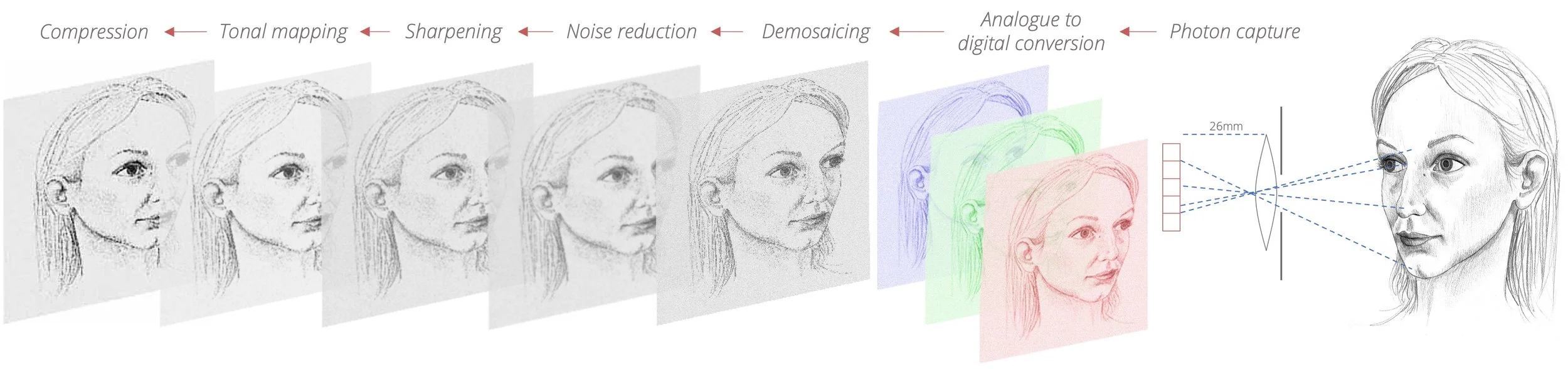
Understanding of digital image capture and processing techniques
Awareness of common compression algorithms, interpolation methods, proprietary formats, and lighting conditions
Knowledge of how resolution, aspect ratio, lighting, blur, compression, and noise affect facial feature detail
Understanding of how image processing can alter or distort morphological information
Participants will also develop practical skills in:
Assessing image suitability for facial comparison based on quality factors
Determining parameters of common image file formats
Applying image processing techniques in a controlled and lossless manner
Interpreting processed imagery and understanding its limitations in comparison tasks
Content
The course is delivered in person over two days and combines taught content with practical exercises using operational-style imagery.
The focus is on understanding how image processing affects the interpretation of facial features, and how this influences decision-making in real-world facial comparison tasks.
Prerequisites
Attendees should be confident in applying morphological analysis and comparison to uncontrolled facial imagery.
Attendees will require a laptop with software for viewing, comparing, and processing facial imagery.
Please get in touch for a quote.